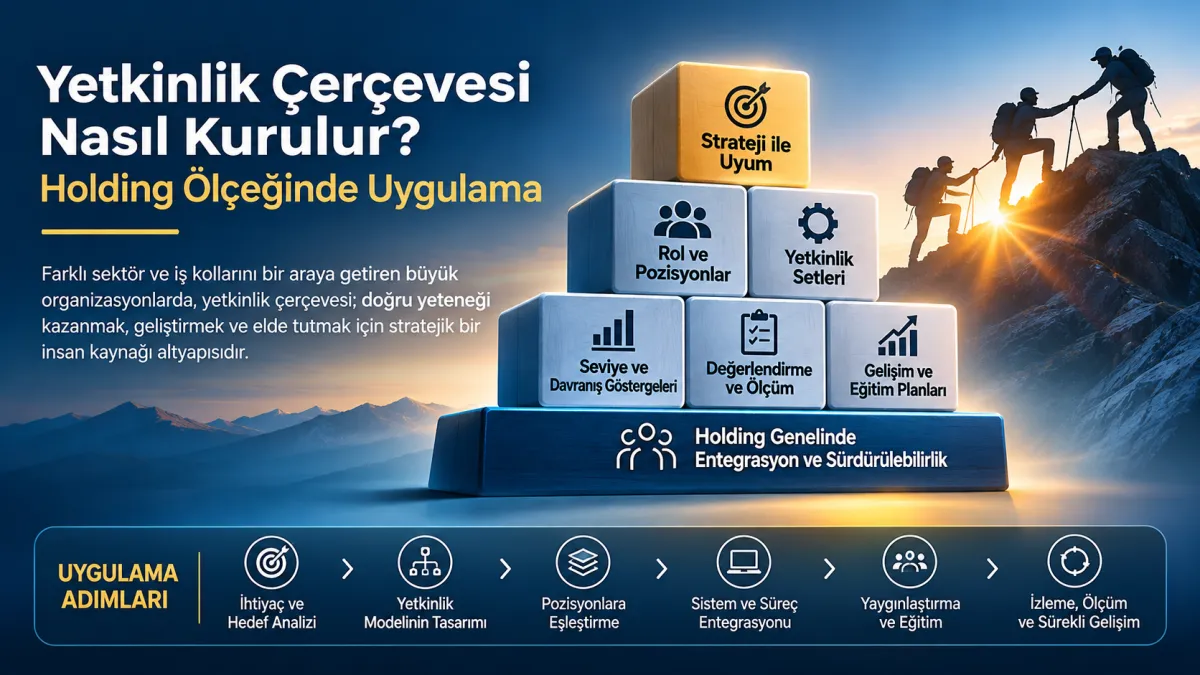
In a holding, hiring, performance reviews, learning plans and promotions often speak different languages. The “leadership” sought in recruitment is not the same as the “leadership” on the appraisal form, and the leadership programme in the training catalogue rests on yet another definition. A competency framework is the backbone that turns this fragmentation into one shared language.
What a competency framework solves
A well-built framework gives the same answer across the organisation to the question “what does it take to succeed in this role?”. Interview questions, the behaviours discussed in performance conversations and the goal of learning investment become connected. A manager’s question (“is this person ready for promotion?”) is answered with observable evidence rather than impressions.
Building it in five steps
- Competency families: define three layers: core competencies for everyone, functional competencies per role family and leadership competencies for management levels.
- Behavioural indicators: describe each competency through observable behaviour. “Communicates well” is not an indicator; “summarises differing views in a meeting and drives them to a joint decision” is.
- Career levels: show how the same competency differs at specialist, senior specialist, manager and director level.
- Role mapping: set which competency is expected at which level for every position, the source for everything from job ads to assessment forms.
- Assessment tools: link structured interview questions, case studies, technical tests and 360-degree feedback to the relevant competencies.
The particular challenge of holding scale
Can a power-plant shift engineer and a hotel front-office manager share one framework? Yes, with the right layering. Core and leadership competencies stay common across the group, while functional competencies differ by sector. This protects group culture and respects what each business specifically needs. It also shows clearly what a manager moving between companies should focus on developing.
A competency framework is not an HR document; it is the organisation’s definition of good work.
Common mistakes
- Defining too many competencies: five to eight per role are enough; more cannot be measured.
- Leaving indicators abstract: an assessor cannot rate a behaviour they cannot observe.
- Writing the framework once and shelving it: competencies must be reviewed as the business model changes.
- Leaving managers out: those who will use the framework must be among those who design it.
When combined with digital platforms
The framework’s real power appears once it is built into digital systems. In the staffing request the manager selects competency levels, the career portal prepares tests and interview questions accordingly, the performance system assesses with the same indicators and the learning plan follows the gaps. One definition becomes an end-to-end talent management chain.