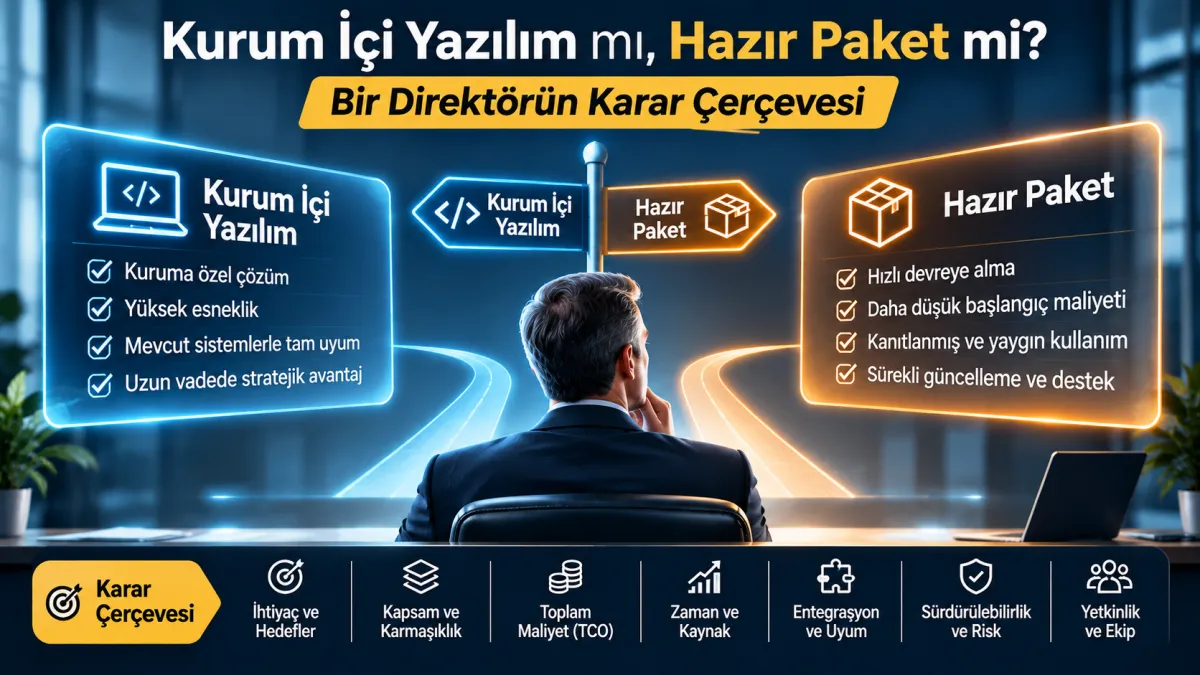
Sooner or later every digital transformation project arrives at the same question: should we build this ourselves or buy a ready-made package? In recent years I have led the delivery of eight enterprise digital platforms, from the career portal to learning and testing systems, compliance tracking and a leadership development platform. For some needs we chose packages, for others in-house development. Here is the framework I use to decide.
The wrong question: “Which is cheaper?”
Decisions are often made on initial cost. The right comparison is five-year total cost of ownership and business value: licences and subscriptions, customisation, integration, maintenance, user training and, above all, how well the system fits the business process. A cheap package that doesn’t fit becomes an expensive habit of people working around the system.
A five-question framework
- Does this process differentiate us? For standard processes such as accounting, a package is almost always right. For processes that create advantage (talent management or our own competency framework), in-house solutions stand out.
- How mature is the process? Buying a large package for an unsettled process locks uncertainty into expensive software. Maturing it first with a small, flexible in-house solution is wiser.
- How much integration is needed? Where heavy data exchange with other systems is required, a solution built to your own rules can significantly cut integration cost.
- Do we have the capacity to sustain it? In-house software isn’t built once and left; it needs lasting ownership for maintenance, security and development.
- Where will the data stay? For processes involving personal data or trade secrets, keeping data on the organisation’s own infrastructure can be decisive for data protection and information security.
The right question is not “who builds the software?” but “who owns this process, and by which rules?”
AI has changed the equation
AI-assisted development tools have sharply reduced the cost and time of in-house software. An application that once took months can now be delivered in weeks by a small team that knows the process well. This shifts the weights in favour of building, but does not reduce the importance of sustainability and security. Every quickly built application still needs an owner, a security review and a maintenance plan.
A hybrid approach
In practice, a hybrid structure often works best: mature packages for core enterprise systems, surrounded by quickly built, well-integrated applications that support the organisation’s distinctive processes. What matters in this architecture is that every application uses the same authentication, the same data definitions and the same security standards.
A final word
Treating build-or-buy as an IT decision is misleading. It is fundamentally a business strategy decision. Any software project without the process owner at the table will struggle to win users over, however good its technical foundation.